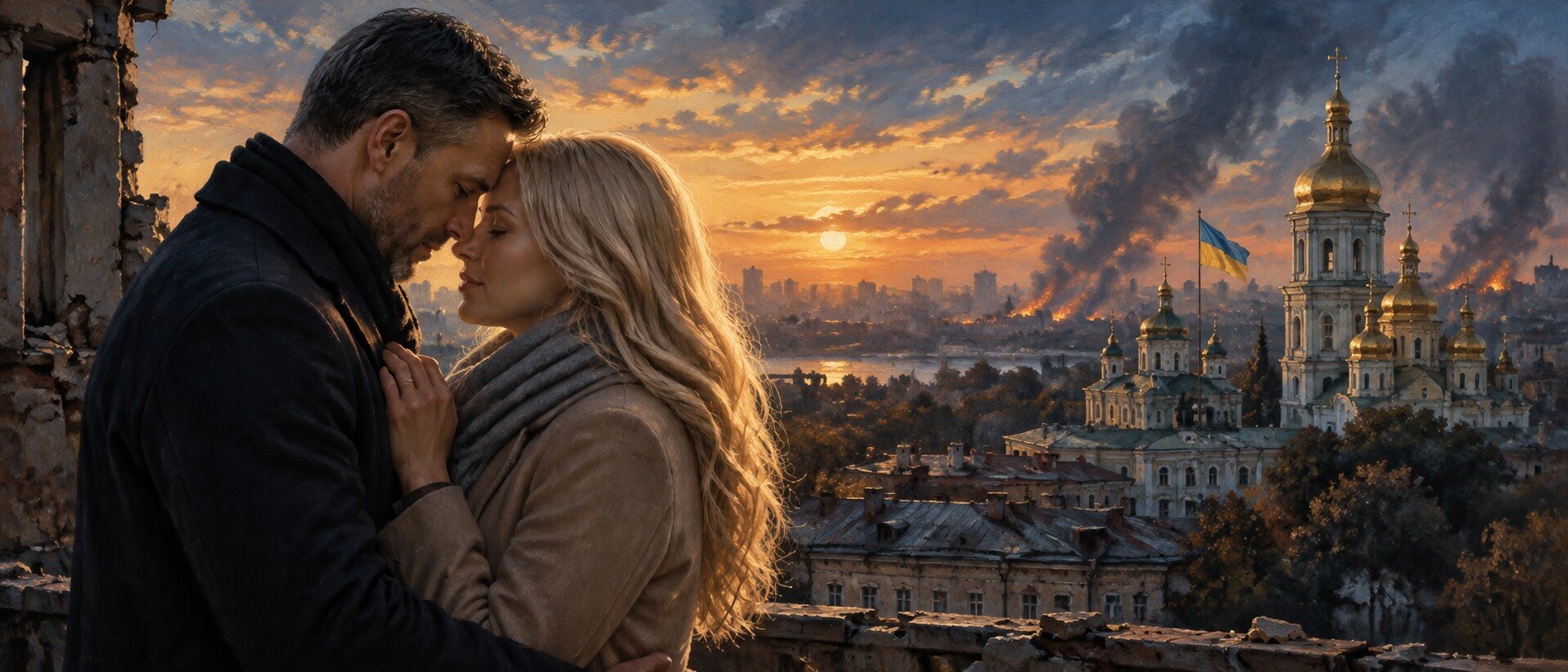
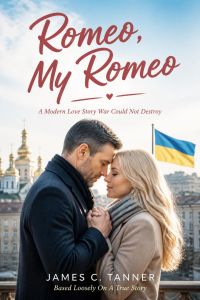
Romeo, My Romeo
Romeo, My Romeo
Some love stories are entertaining. Some are moving. Very few are real.
Romeo, My Romeo is all three.
Written by James C. Tanner and published through Calico GOLD Books, Romeo, My Romeo is a contemporary romance novel that does something no other romance novel has done — it puts the reader inside a real love story, in real time, through real emails written during active missile attacks in a country at war.
This is not a book about love as a concept. It is a book about love as an act — specific, costly, and absolutely refused to be stopped by distance, danger, or the full weight of a world on fire.
What Is Romeo, My Romeo About?
Romeo, My Romeo begins where most love stories never go — not at the beginning of romance, but at the moment romance becomes something larger than itself.
A widowed North American man and a Ukrainian woman meet on an international dating site. Their first evening together lasts less than an hour before a fire alarm tears them apart. She flies home to Ukraine. He flies home to an empty house. Neither can forget the other.
Then war arrives.
Her emails begin carrying what her words cannot quite say — a shaking fear, an unspoken longing, the weight of a woman whose heart cries to have her man at her side. She never asks him to come. She knows the danger. She would never ask for that.
Without being asked, without hesitation, he abandons everything and flies into a country on fire.
Through missile attacks, drone strikes, and broken roads, he keeps moving. Always one day behind her. Never once looking back.
Romeo, My Romeo is the story of what happens next — and what it costs, and what it means, and why neither of them could have done anything differently.
The Real Emails That Make Romeo, My Romeo Unlike Any Other Romance Novel
What sets Romeo, My Romeo apart from every other romance novel is not the story — though the story is extraordinary. It is the evidence.
The real emails between Cal and Dasha — the fictional characters whose lives are at the center of this book — appear throughout the novel. These are not dramatized reconstructions. They are not written to sound authentic. They are authentic.
When a reader encounters a message from Dasha written inside a bomb shelter, they are reading the real words of the real woman who wrote them. When she writes “We are trapped…” the reader is not experiencing a novelist’s imagination of fear. They are experiencing the actual fear of an actual woman in an actual moment of genuine danger.
This is what makes Romeo, My Romeo an interactive novel in the deepest sense — not just in the formal sense that readers are invited to write directly to Cal and Dasha and receive personal responses in character, but in the emotional sense that the reader is pulled out of the comfortable distance that fiction usually provides and placed directly inside the experience.
You are not reading about a woman in a bomb shelter. You are reading her words from inside one.
That is something no other romance novel has achieved — and it changes everything about how the story lands.
Who Are Cal and Dasha?
Cal
Cal is a widowed North American man who had stopped believing that what he found with his late wife could ever be found again. He was not looking for a great love story. He was looking, perhaps, for companionship — for something that might make the empty house feel less empty.
What he found was something he had no category for. A woman on the other side of the world who was teaching traumatized children to sing again in the shadow of war — and who, in the course of a single evening that lasted less than an hour, made him feel something he had buried so deeply he had almost forgotten it was there.
When war came for her, Cal did not calculate the risk. He did not weigh the odds. He bought a ticket and flew into a country on fire because the alternative — staying safe while she was in danger — was simply not something he was capable of choosing.
Cal is not a hero in the conventional sense. He is something rarer — a man who loved someone more than he loved his own safety, and acted accordingly.
Dasha
Dasha is a Ukrainian woman of extraordinary grace and courage — a teacher who had chosen to stay in her country, to serve her community, to help children find their voices again in the middle of a war that was trying to silence everything.
She had never stopped believing in forever. But she had learned not to expect it. Life had taught her that the things worth wanting were also the things most likely to be taken away.
When Cal appeared — briefly, incompletely, separated by a fire alarm before anything could be properly said — she carried the memory of him carefully, the way you carry something fragile across difficult ground.
Her emails to him, as the war intensified, said everything her words could not quite say directly. The longing was there. The fear was there. And underneath both — a love she would not ask him to risk his life for, no matter how much she needed him.
He came anyway.
The Shakespeare Parallel in Romeo, My Romeo
The title Romeo, My Romeo is not accidental. The parallel to Shakespeare’s most enduring love story is deliberate — and it runs deeper than the names.
Romeo and Juliet is not, at its core, a story about young love. It is a story about love that refuses to be contained by the world around it — love that insists on its own reality in the face of forces that say it cannot, should not, will not survive.
Cal and Dasha face a different set of forces than Shakespeare’s lovers — not warring families but a warring world, not a poison misunderstanding but missile attacks and broken roads and a country burning around them. But the essential dynamic is the same — two people whose love is larger than the circumstances trying to prevent it, who choose each other anyway, who refuse to let the world’s cruelty be the final word.
While the whole world watched their love letters on the evening news and called them Romeo and Juliet — while strangers across continents united in the desperate hope of reuniting two people searching for their happy ever after — she was running for her life. And he was coming for her anyway.
Because true love doesn’t count the cost. It doesn’t measure the distance. It doesn’t stop at the border of a war zone. It simply refuses to let go.
Romeo, My Romeo as an Interactive Novel
One of the most extraordinary features of Romeo, My Romeo is its interactive dimension.
Readers are warmly invited to write directly to Cal and Dasha — the fictional characters at the heart of the story — and to receive personal responses in character. This is not a marketing gimmick. It is an extension of the novel’s deepest conviction — that some love stories don’t end on the last page.
The decision to make Romeo, My Romeo interactive reflects something important about what James C. Tanner was trying to do with this book. A love story this real, this specific, this grounded in actual human experience — it deserves to keep living after the final chapter. The characters deserve to keep existing in the world, to keep responding to the people who have been moved by their story.
For readers who have ever wanted to step inside a story and say something to the people in it — Romeo, My Romeo makes that possible.
Why Romeo, My Romeo Matters Beyond Romance
Romeo, My Romeo is filed under romance — and it is, without question, a love story of the deepest kind. But it is also something more than that.
It is a document of war as it is actually experienced by the people living inside it — not the geopolitical analysis, not the satellite images, not the press briefings, but the human texture of it. The fear that shows up in an email. The longing that cannot be said directly. The courage of a woman who keeps teaching children to sing while missiles fall.
It is a testament to what ordinary people are capable of when love asks something extraordinary of them. Cal is not a soldier. He is not trained for what he does. He is a man who loves a woman, who gets on a plane, who keeps moving through a country on fire because turning back was never a real option.
And it is, ultimately, an argument — the most personal and powerful kind of argument — that love is not a feeling that happens to people. It is a choice that people make, repeatedly, at increasing cost, in the full knowledge of what it might take from them.
Romeo, My Romeo makes that argument not through sentiment but through evidence. The emails are real. The fear is real. The love is real. And the choice — to come anyway, to keep moving, to refuse to let go — is as real as anything that has ever been documented between two human beings.
About the Author
Romeo, My Romeo is written by James C. Tanner — author of more than 70 published titles across geopolitics, personal development, and fiction, and the founder of Calico GOLD Publishing.
Romeo, My Romeo is Tanner’s first work of fiction — and it draws on the most personal material he has ever put into print. The novel is based loosely on a real couple’s perilous journey to find a forever love — a journey that Tanner witnessed closely enough to know that no fictional embellishment was needed. The truth, as it so often is, was already more extraordinary than anything a novelist could invent.
Frequently Asked Questions About Romeo, My Romeo
What is Romeo, My Romeo about?
Romeo, My Romeo is a contemporary romance novel about a North American man who flies into war-torn Ukraine to find the woman he loves — based loosely on a real couple’s journey to find each other across impossible distances.
Are the emails in Romeo, My Romeo real?
Yes. The real emails between the characters, including messages written during active missile attacks and from inside a bomb shelter, appear throughout the novel. Readers experience the actual words of the actual people who wrote them.
What does it mean that Romeo, My Romeo is an interactive novel?
Readers are invited to write directly to Cal and Dasha — the fictional characters in the novel — and receive personal responses in character. Some love stories don’t end on the last page.
Is Romeo, My Romeo based on a true story?
The novel is based loosely on a real couple’s perilous journey to find a forever love. The core events — the meeting, the separation, the war, the decision to come anyway — are grounded in real experience.
Who wrote Romeo, My Romeo?
Romeo, My Romeo is written by James C. Tanner, author of more than 70 published titles and the founder of Calico GOLD Publishing.
Where can I buy Romeo, My Romeo?
The ebook is available through the Calico GOLD Publishing store. The paperback is available on Amazon.
Get Your Copy of Romeo, My Romeo
Romeo, My Romeo is available now as an ebook through Calico GOLD Publishing — $6.99, delivered instantly as a download.
Paperback available on Amazon: Romeo, My Romeo on Amazon
Published by Calico GOLD Books — a division of Calico GOLD Publishing.